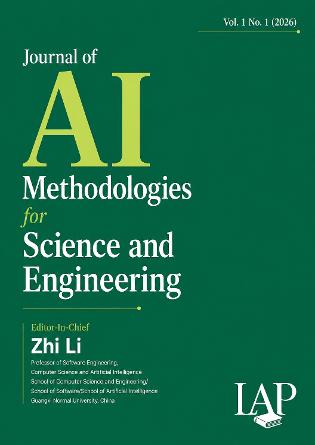
Journal of AI Methodologies for Science
and Engineering
ISSN : Under Process
Editor in Chief
Prof. Zhi Li
Professor of Software Engineering, Computer Science and Artificial Intelligence
School of Computer Science and Engineering/School of Software/School of Artificial Intelligence
Guangxi Normal University
Email: zhili@gxnu.edu.cn
Click Here to for Complete List of Editorial Board
Aim
The Journal of AI Methodologies for Science and Engineering (AIMSE) is an international, peer reviewed, open access journal dedicated to advancing AI driven methodologies that underpin discovery, modeling, simulation, optimization, and decision making across the natural sciences, applied sciences, and all branches of engineering. AIMSE bridges foundational AI research and domain specific scientific/engineering practice, publishing rigorous, reproducible, and impactful work that develops, validates, and deploys novel AI methods to solve longstanding and emerging challenges in science and engineering. The journal promotes interdisciplinary collaboration, methodological transparency, ethical and responsible AI, and translational impact for academia, industry, and society.
Scope
AIMSE welcomes original research articles, comprehensive reviews, technical notes, methodological protocols, and application case studies that advance AI methodologies for science and engineering. Topics include, but are not limited to:
1. Foundational AI Methodologies
• Novel machine learning, deep learning, reinforcement learning, and meta heuristic algorithms tailored for scientific/engineering data and systems
• Probabilistic modeling, uncertainty quantification, and causal inference for scientific prediction and engineering design
• Optimization, inverse problems, and surrogate modeling for computational science and engineering
• Automated reasoning, knowledge representation, and symbolic AI for scientific discovery and engineering logic• Federated learning, edge AI, distributed AI, and multi agent systems for large scale scientific/engineering workflows
2. AI for Scientific Domains
• AI in physics, chemistry, materials science, earth sciences, environmental science, and astronomy
• AI for computational biology, bioinformatics, computational medicine, and health sciences
• AI driven data science, big data analytics, and high performance computing for scientific simulation• AI for experimental design, automated measurement, and scientific instrument control
3. AI for Engineering Disciplines
• AI in mechanical, aerospace, civil, chemical, electrical, electronics, and biomedical engineering
• AI for manufacturing, process control, predictive maintenance, digital twins, and smart factories
• AI for engineering design, reliability analysis, fault detection, and system optimization
• AI for energy systems, transportation, smart cities, infrastructure, and sustainability engineering• AI for robotics, autonomous systems, human–machine interaction, and intelligent automation
4. Responsible and Trustworthy AI for Science and Engineering
• Explainable AI (XAI) and interpretable models for scientific/engineering transparency
• Ethical, fair, robust, and secure AI for critical engineering and scientific applications
• Reproducibility, validation, and benchmarking of AI methods in science and engineering• Regulatory, safety, and societal implications of AI enabled science and engineering
Article Types
• Original Research Articles
• Comprehensive Review Articles
• Methodological Briefs / Technical Notes
• Application Case Studies
• Perspective / Vision Articles• Special Issue Collections on emerging themes
Target Audience
Researchers, engineers, data scientists, practitioners, and graduate students in artificial intelligence, machine learning, computational science, applied mathematics, and all engineering and scientific disciplines that use or develop AI methodologies.
Core Values:
• Methodological rigor and reproducibility
• Interdisciplinarity and cross domain translation
• Open science and open access
• Ethical and responsible innovation• Practical impact for science and industry
Submission: Authors are requested to submit their papers electronically to zhili@gxnu.edu.cn
Indexing and Abstracting: Google Scholar, Zenodo, OpenAIRE, Digital Object Identifier, Index Copernicus, Academia
Start Year: 2026
Subject Area: Artificial Intelligence
License(s) permitted by the journal: All articles are published under a Creative Commons Attribution License (CC BY 4.0). This license enables users to share, adapt, and build upon the material for any purpose, even commercially, as long as proper attribution is given to the author(s). More information about the CC BY license can be found at the Creative Commons website.
Language of the journal: English
Open Access Statement: The Journal of AI Methodologies for Science and Engineering is an open access journal Click Here to Read More...
Frequency: Two issues per year are published.
Article Processing Charges: The journal publishes articles in Open Access Model. In this Open Access model, the publication cost should be covered by the author's institution or research funds. These Open Access charges replace subscription charges and allow the publishers to give the published material away for free to all interested online visitors. The charges for page charges in the journal are $ 100.
Publication Format: Online
Artificial Intelligence (AI) Policy: The Journal of AI Methodologies for Science and Engineering embraces Generative AI (GenAI) tools as supportive aids to enhance research quality and efficiency in data analysis, stochastic modeling, and related fields, while upholding the highest standards of academic integrity and originality. Click here to read more...
Website: www.journal-aimse.com
Focus of the journal: AI driven methodologies that underpin discovery, modeling, simulation, optimization, and decision making across the natural sciences, applied sciences, and all branches of engineering
Plagiarism: All the articles will be check through Turnitin Software before the publication of the journal.
Abbreviation: J. AI Methodol. Sci. Eng.
Sample Article: WORD
Review Process: This journal uses double-blind review, which means that both the reviewer and author identities are concealed from the reviewers, and vice versa, throughout the review process. The articles is submitted to minimum 3 reviewers specialize on the topic for their reviews. Click Here to Read More
Corrections to Published Work:
Honest errors are a part of research and publishing and require publication of a correction when they are detected. We expect authors to inform the Journal’s Editor of any errors of fact they have noticed or been informed of in their article once published. Corrections are made at the journal’s discretion. The correction procedure depends on the publication stage of the article, but in all circumstances a correction notice is published as soon as possible. Details can be found on the Call for Papers section of the journal website.
Retractions: Retractions are considered by journal editors in cases of evidence of unreliable data or findings, plagiarism, duplicate publication, and unethical research. We may consider an expression of concern notice if an article is under investigation. All retraction notices will explain why the article was retracted. The retraction procedure depends on the publication stage of the article.
" Journal of AI Methodologies for Science and Engineering."
Editor-Prof. Zhi Li
© Copyright Journal of AI Methodologies for Science and Engineering